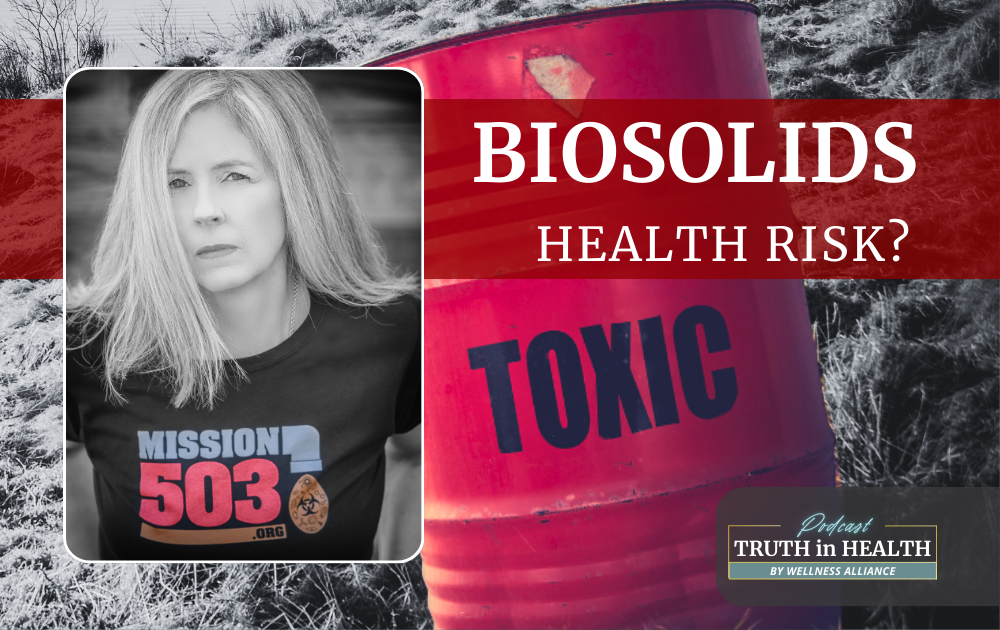
Chip Paul sits down with Mission 503 founder Paula Yockel to discuss biosolids, concerns surrounding the land application of treated sewage solids, and her organization’s work to raise awareness about potential impacts on communities, farmland and public health.
Watch the Episode

Listen to the Podcast
Truth in Health Podcast S1E2: Biosolids, Public Health, and the Mission to Stop Sewage Dumping on American Land
Across the United States, millions of acres of land are used for farming, grazing, and residential living. What many people don’t realize is that some of this land is also used for the disposal of municipal sewage solids—commonly referred to as biosolids.
In Season 1, Episode 2 of the Truth in Health Podcast, host Chip Paul speaks with Paula Yockel, founder of Mission 503, about how this practice became federally permitted, the public health risks communities face, and why Mission 503 is advocating for major infrastructure reform.
What Are “Biosolids”?
“Biosolids” is the industry term for treated sewage solids left behind after wastewater treatment. While modern infrastructure focuses heavily on cleaning water, far less attention is given to how the remaining solids are managed.
Under the federal 40 CFR Part 503 rule, these sewage solids are permitted to be spread on land and are often marketed as fertilizer. According to Mission 503, this rule focuses on limited testing standards and does not require testing for many pathogens, pharmaceuticals, or antibiotic-resistant organisms.
A Personal Story That Sparked a National Mission
Paula Yockel’s advocacy began after she and her husband unknowingly purchased land within a long-standing sewage disposal corridor outside Oklahoma City. Over time, trucks began dumping treated sewage on neighboring land—often near homes and wells.
The first warning sign was odor. But odor is more than a nuisance—it represents airborne particles, gases, and compounds capable of traveling across property lines and into homes.
As health problems mounted, Paula began questioning the assurances that the practice was safe. That inquiry eventually led to years of research and the founding of Mission 503.
Health Concerns and Scientific Findings
Between 2008 and 2016, Mission 503 worked with laboratories and researchers across the country to analyze sewage samples, air exposure, and post-application land conditions.
Their findings revealed the presence of antibiotic-resistant pathogens, including:
- Staphylococcus aureus
- Pseudomonas aeruginosa
- Acinetobacter baumannii
In some cases, these organisms were still present 30 days after land application, raising concerns about prolonged exposure risks for nearby communities.
Why Infrastructure Must Change
Mission 503 emphasizes that policy changes alone are not enough. America’s wastewater infrastructure was designed to clean water—not to safely manage massive volumes of sewage solids.
Without new infrastructure solutions, simply banning land application would leave municipalities without viable alternatives. Mission 503 advocates for modern systems that protect communities, farmland, and public health.
Mission 503’s Call to Action
Mission 503 is now focused on national awareness and federal engagement. The organization has released an open video letter to the Trump administration and the American people, outlining research findings and proposed solutions.
This issue is non-partisan and fundamentally about public health.
Learn more, view research, and watch the open video letter:
https://mission503.org/get-informed
📜 Full Episode Transcript
For accessibility and transparency, the complete transcript of this episode is available below.
View the Full Transcript (Google Drive)
The transcript is provided in a clean, readable format and reflects the full recorded conversation.
About the Truth in Health Podcast
The Truth in Health Podcast explores the intersection of environmental health, public policy, science, and lived experience. Hosted by Chip Paul, the show creates space for important conversations impacting individuals, families, and communities nationwide.
Learn More
View Full Transcript
Chip Paul:
Welcome back to the Truth in Health Podcast. Today, we’re very lucky to have with us Paula Yockel, founder of the nonprofit Mission 503. Paula is here to tell us about Mission 503, how it started, and why this issue affects all of us. Welcome to the podcast, Paula. It’s a pleasure to have you today.
Paula Yockel:
Good morning. Thank you so much for having me. I’m glad to be here. This is an important subject that affects all of us, and I really appreciate the opportunity to talk about it.
The Origin of Mission 503
Chip Paul:
Let’s start with the origin story. What got you involved in this cause?
Paula Yockel:
Mission 503 was founded to stop the land disposal of our nation’s sewage nationwide and to lead the way toward new infrastructure solutions that properly manage sewage solids. Right now, we don’t have infrastructure that properly handles sewage solids, and that’s one of the biggest obstacles we have to overcome. But I believe it can be done.
Chip Paul:
People sometimes call this biosludge or biosolids. Is that the same thing?
Paula Yockel:
Yes. The marketed name is biosolids. Some people call it biosludge or humanure. I call it sewage, because that’s what it is. The term “biosolids” came from a very deliberate public relations effort. There’s actually a book called Toxic Sludge Is Good for You that explains how the PR industry worked hard to make dumping sewage on farmland seem acceptable—and they were very successful.
A Personal Wake-Up Call
Chip Paul:
This became personal for you. Tell us what happened.
Paula Yockel:
My life’s mission was never to deal with the nation’s sewage. My husband and I were looking for land outside the city to build our dream home. We had no idea we had purchased land in a corridor where Oklahoma City had been dumping sewage for decades.
This isn’t just an Oklahoma City issue—it’s happening across the nation under federal rule.
Chip Paul:
Was that disclosed when you bought the property?
Paula Yockel:
No. It didn’t have to be. It’s promoted as fertilizer under the federal rule—40 CFR Part 503. That’s where the name Mission 503 comes from. There’s no requirement to disclose it because it’s marketed as beneficial.
Municipal sewage goes through treatment plants where water is separated from solids. The water is cleaned and reused. The solids are what nobody knows what to do with—so they get dumped on farmland. Our wastewater system is all about water, not solids.
When the Dumping Became Visible
Chip Paul:
When did you realize something was really wrong?
Paula Yockel:
We bought our place in 2004 and weren’t home much at first. Occasionally you’d smell something, but the wind would change and it would go away.
In 2008, I saw trucks pulling onto the pasture next to our home—convoys of them—dumping black, oozing, atrocious muck. That’s when I visually understood what was happening.
I started calling officials, writing letters, trying to stop it. I was told, “We’ve been doing this forever. It’s safe. It’s good for the soil.”
Health Impacts
Chip Paul:
Did your family experience health issues?
Paula Yockel:
Yes. The first thing you notice is odor—but odor is made up of molecules, particulates, gases, VOCs. When sewage is dumped near your home, especially downwind, you can get sick within hours.
We experienced headaches, nausea, gastrointestinal distress, eye infections, respiratory infections—you name it. Climate matters. Fog, moisture, and wind carry everything from that sewage across fences and into homes. It travels for miles.
Some of the most dangerous things in sludge are odorless and invisible.
Federal Rule and Testing Gaps
Chip Paul:
What does the federal rule actually test for?
Paula Yockel:
The rule requires testing for nine metals and one fecal indicator. That’s it. It does not test for pathogens. It does not test for pharmaceuticals. It does not test for antibiotic resistance.
We were even told at one point that the sewage was “sterile,” which is completely false.
From Complaints to Research
Chip Paul:
Did you contact lawmakers?
Paula Yockel:
Yes. From 2008 to 2015 we contacted state officials, federal regulators, EPA offices, agricultural offices—you name it. Everyone pointed fingers because the federal rule allows it.
Eventually, we decided to test it ourselves. We requested samples. Because it’s “just fertilizer,” they allowed us to collect them.
We sent sludge samples to labs across the country. What we found was shocking.
Scientific Findings
Paula Yockel:
We found active pathogens and antibiotic-resistant organisms. Thirty days after land application, we were still growing three of the most dangerous antibiotic-resistant bacteria:
- Staphylococcus aureus
- Pseudomonas aeruginosa
- Acinetobacter baumannii
These organisms were still alive on pastures where cattle graze.
Personal Sacrifice
Chip Paul:
This came at a huge personal cost, didn’t it?
Paula Yockel:
Yes. We became incredibly sick. I lost so much weight my clothes wouldn’t stay on. My husband suffered severe skin infections. We nearly lost our son.
Eventually, we had to leave our home. We couldn’t sell it in good conscience, knowing it made us sick. A neighbor who understood the situation eventually bought it from us.
Every spare dollar went to medical bills and research. But we couldn’t turn our backs once we understood what was happening.
Why Mission 503 Exists
Paula Yockel:
We realized the root problem isn’t just industry—it’s the federal rule. It promotes land disposal of sewage and deceives farmers. We are dumping our nation’s sewage where millions of Americans live.
You cannot make America healthy again while dumping sewage on our land. Those two things are incompatible.
Call to Action
Chip Paul:
What can people do to help?
Paula Yockel:
Visit our website. Get informed. Sign the petition. Share our work. We released an open video letter to President Trump, Secretary Kennedy, and the American people. It’s ten minutes long and lays out the facts and solutions clearly.
We’re asking for public awareness and support so we can push for infrastructure change. Policy alone is meaningless without infrastructure.
Closing
Chip Paul:
Paula, thank you for your courage and persistence. This is an incredibly important issue, and we fully support your mission.
Paula Yockel:
Thank you. Only by the grace of God and the courage of researchers across the nation have we gotten this far. If we want to make America healthy again, we must stop dumping our nation’s sewage where people live. Join us.


