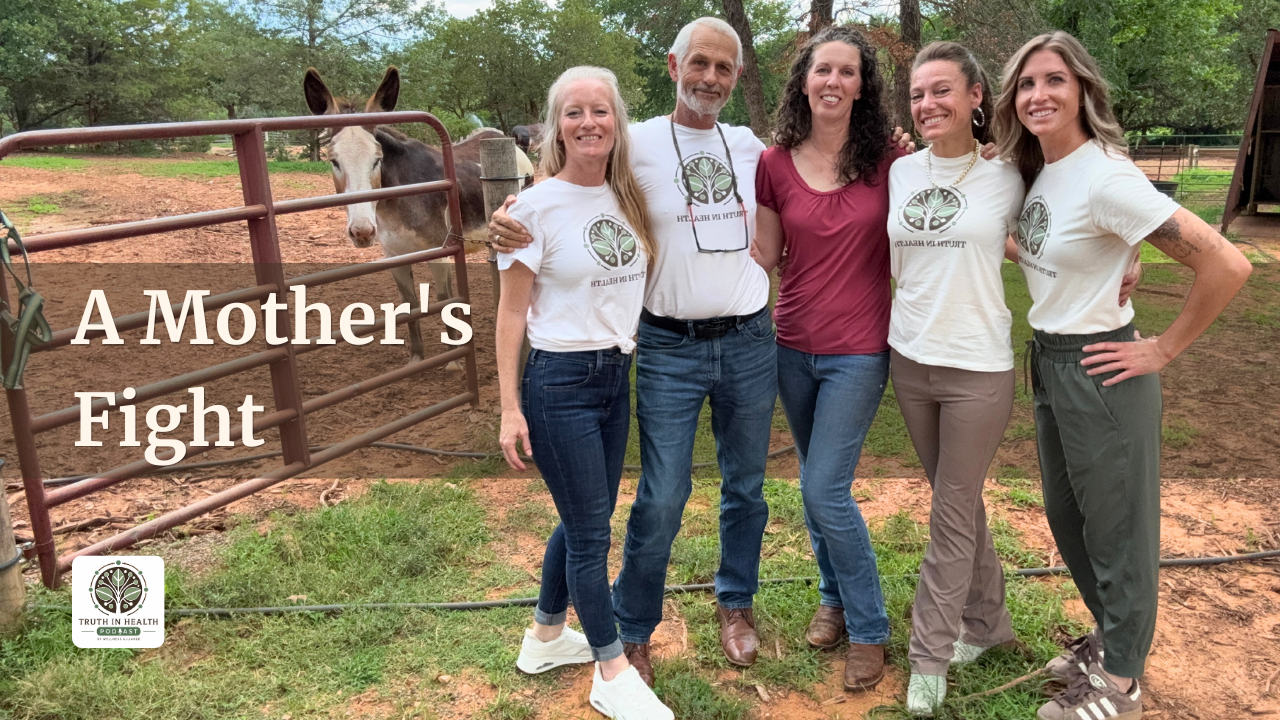
Cindy Paul, Chip Paul, Paige Grellner and Keysha James sit down with Oklahoma Donkey Dairy founder Saundra Traywick to hear the remarkable story of how one family’s search for answers during a difficult childhood health journey led to donkey milk, a rare Oklahoma dairy, agricultural advocacy and a growing mission to help other families.
Episode Timestamps
00:00 – Welcome to Oklahoma Donkey Dairy
02:05 – A Mother's Fight: When Everything Changed
05:40 – Understanding PANDAS & the Search for Answers
10:20 – Why Camel Milk Led to Donkey Milk
17:15 – The First Time She Said "I Love You" Again
21:00 – Donkey Milk, Gut Health & Emerging Research
30:45 – Building Oklahoma Donkey Dairy
35:30 – Advocacy, Family Farms & Regulatory Challenges
42:20 – Hee Haw for Health: Helping Other Families
46:30 – Hope, Community & Looking Ahead
49:09 – Final Thoughts & Closing
Watch the Episode

Listen to the Podcast
Educational Notice: This article and podcast are provided for educational and informational purposes only. The experiences shared by our guest reflect her family's personal journey and observations. Discussions about nutrition, foods and emerging research are intended to encourage informed conversations and should not be interpreted as medical advice or as claims that any food or dietary ingredient diagnoses, treats, cures or prevents disease. Individual experiences vary.
When a Child Changes Overnight
Every parent hopes their child will grow up healthy, happy and full of possibility.
For Saundra Traywick, that hope was shaken when her six-year-old daughter experienced a sudden and dramatic change that left their family searching for answers.
Saundra recalls the sudden appearance of obsessive-compulsive behaviors, anxiety, emotional outbursts, food aversions, hallucinations and other neurological symptoms. Her daughter struggled to eat or drink, and everyday objects suddenly became "contaminated."
That frightening experience became the beginning of a journey that would eventually lead to one of Oklahoma's most unusual farms—and a growing mission centered on education, agriculture and helping other families navigate difficult health journeys.
A Rare Diagnosis
Within days, Saundra found a physician familiar with PANDAS (Pediatric Autoimmune Neuropsychiatric Disorders Associated with Streptococcal infections). Although her daughter showed few of the classic symptoms of strep throat, testing confirmed a streptococcal infection.
Saundra recalls that awareness of the condition was limited at the time. The active infection responded to antibiotics, but many of the neurological symptoms remained.
Her family continued searching for information and working to understand what might help their daughter.
Refusing to Stop Searching
Saundra continued reading scientific literature, learning about nutrition, exploring complementary approaches and connecting with other parents facing similar challenges.
"If they're going to be guessing, we can do our own researching, praying, and see where the Lord leads us."
Her family's search eventually introduced her to discussions surrounding camel milk and its nutritional properties. Obtaining it consistently, however, proved difficult.
For a time, the family even considered purchasing camels. Then, during a visit to an Oklahoma camel farm, someone offered another suggestion:
"What about donkey milk?"
The Unexpected Road to Donkey Milk
After months of searching for answers, Saundra was willing to keep learning. She introduced donkey milk into her daughter's routine and remembers a moment shortly afterward that became deeply meaningful to their family.
Her daughter looked at her father and said:
"I love you, Daddy."
Saundra says those were words the family had not heard since her daughter became ill. Later that same day, her daughter told her grandparents she loved them as well.
For Saundra, those moments became powerful parts of her family's story. Personal experiences like these cannot establish scientific conclusions or prove that a particular food caused a health change. But for her family, the experience inspired years of continued education, research and eventually farming.
Understanding the Interest in Donkey Milk
During the conversation, the group explores why donkey milk has attracted scientific and nutritional interest.
Donkey milk differs from cow's milk in several ways, including aspects of its protein profile and naturally occurring compounds. The conversation touches on research involving:
- Lysozyme
- Lactoferrin
- Whey proteins
- Immunoglobulins
- Extracellular vesicles and exosomes
- The gut microbiome
These remain areas of ongoing research, and many questions about their biological and clinical significance continue to be investigated.
More Than a Dairy
What started as one family's search for answers eventually grew into Oklahoma Donkey Dairy.
Today, Saundra and her family raise American Mammoth Jackstock donkeys while placing an emphasis on animal welfare, preserving rare genetics and educating visitors about the animals and their agricultural history.
But Saundra's work didn't stop at the farm.
Agriculture, Advocacy and Community
As Saundra became more involved in agriculture, she also became passionate about family farms, environmental stewardship and educating Oklahomans about issues affecting agriculture.
Those efforts eventually led to Save Oklahoma Farms & Ranches, where she works alongside other advocates around agricultural issues and responsible land stewardship.
Saundra also founded Hee Haw for Health, a nonprofit focused on helping families navigating childhood chronic illness and neuroinflammatory conditions.
The organization hosts family-friendly educational events at Oklahoma Donkey Dairy where parents can hear from health professionals and learn about available resources while children enjoy activities on the farm.
Through scholarships and community partnerships, Hee Haw for Health seeks to make educational opportunities and wellness resources more accessible to families.
A Shared Mission
Throughout our conversation with Saundra, one thing became clear: this story is about much more than donkey milk.
It's about a mother's determination to keep asking questions.
It's about families trying to navigate complicated health situations.
It's about supporting local agriculture and preserving family farms.
And it's about what can happen when people share their experiences, ask thoughtful questions and create resources that help others feel less alone.
What We Hope You Take From This Conversation
- Parents and caregivers can be important advocates for their families.
- Complex health journeys rarely have simple answers.
- Nutrition and the gut microbiome remain active areas of scientific research.
- Personal experiences can raise important questions without replacing scientific evidence.
- Local agriculture, education and community connection can all be part of broader conversations about health.
About Saundra Traywick
Saundra Traywick is the founder of Oklahoma Donkey Dairy, Dulce de Donké, Hee Haw for Health and Save Oklahoma Farms & Ranches. Based near Luther, Oklahoma, she and her family operate a donkey dairy while educating the public about agriculture, the animals they raise and their family's journey.
Beyond the dairy, Saundra advocates for family farms, agricultural stewardship and health education. Through Hee Haw for Health, she works to create educational opportunities for families navigating complex childhood health challenges.
About Truth in Health
Truth in Health Association is a nonprofit organization bringing together health professionals, educators, farmers, community leaders, organizations and Oklahomans through education, conversation and connection.
Stories like Saundra's are one part of that mission. We create space for people to share experiences, explore important questions, learn from one another and connect our community with people and resources that may otherwise remain disconnected.
Help Us Keep Bringing These Stories to the Community
Truth in Health is a nonprofit built around education, connection and community. Your membership and support help us continue creating conversations like this and bringing together families, health professionals, educators, farmers and community leaders whose experiences and knowledge deserve to be shared.
Educational & Medical Disclaimer
The information presented in this article and podcast is intended for educational purposes only. Guest experiences are personal and should not be interpreted as scientific proof or medical advice. References to foods, nutrition and emerging research are provided to encourage informed discussion and should not be interpreted as claims that any food or dietary ingredient diagnoses, treats, cures or prevents disease. Individuals should consult qualified healthcare professionals regarding medical concerns and before making changes to diet, treatment or medications.
View Full Transcript
Interview Transcript (Edited for Readability)
Editor's Note: The following transcript has been lightly edited for readability. Minor grammatical corrections, filler words, and repeated phrases have been removed while preserving the meaning and intent of the conversation.
Welcome to Oklahoma Donkey Dairy
Cindy Paul:
Hi, everyone! I'm Cindy Paul, Executive Director of Truth in Health.
Today we're visiting one of Oklahoma's most unique farms—Oklahoma Donkey Dairy.
When most people hear the words donkey milk, they're surprised. But this story is about much more than milk. It's about helping children, exploring nutrition, and learning how one family's determination led them down an unexpected path.
Today we'll see how the donkeys are cared for, how the milk is produced, and hear the remarkable story behind this family farm.
Let's head inside and meet Saundra Traywick.
Meeting the Donkeys
(The team tours the farm before sitting down for the interview.)
Saundra Traywick:
Welcome! They aren't paying attention to us—they're wondering where the food is.
Paige Grellner:
They really are beautiful.
Saundra:
Come on down. Just try not to get drenched.
Paige:
Are they protective?
Saundra:
No, not at all.
More Than a Story About Donkey Milk
Chip Paul:
Saundra, thank you for welcoming us to your beautiful farm.
Today we want to talk about much more than donkey milk.
We want to learn about your family's journey, how all of this began, what you've discovered along the way, and some of the health discussions surrounding donkey milk.
Paige is going to start at the beginning of your story, and I'll jump in throughout the conversation with some of the science.
Where It All Began
Paige Grellner:
Before we sat down, your daughter gave us a wonderful tour and introduced us to the donkeys.
There's obviously a much bigger story here.
Let's go back to the beginning.
Tell us about your daughter.
When Everything Changed
Saundra Traywick:
My daughter is 18 now and getting ready to leave for college. She's doing wonderfully today.
But when she was six years old, everything changed almost overnight.
She had been healthy and developing normally. Then suddenly she developed severe OCD, anxiety, emotional outbursts, separation anxiety, food aversions, hallucinations, and other neurological symptoms.
It was as though someone had flipped a switch.
At first, I thought she might have a brain tumor because the change was so dramatic.
She could barely eat.
She could barely drink.
Everything became contaminated in her mind.
Imagine trying to explain that coming from a six-year-old child.
I spent every spare minute researching because I knew something serious was happening.
Finding a Diagnosis
Saundra:
During my research, I found references to autoimmune conditions causing neurological symptoms, but I couldn't find a clear diagnosis.
We were incredibly fortunate to get in with a doctor in Tulsa.
He didn't even need to examine her.
I simply listed everything that had happened.
He looked at me and said,
"I could keep you as my best patient for the next twelve years...or I can tell you she has PANDAS."
That diagnosis changed everything.
PANDAS stands for Pediatric Autoimmune Neuropsychiatric Disorders Associated with Streptococcal infections.
There is also PANS, but my daughter fit the classic PANDAS presentation.
The surprising part was that she actually had strep throat and we didn't know it.
She never developed a fever.
She didn't complain about her throat.
The only clue was unusually bad breath, which I later learned can sometimes accompany strep infections.
A Mother's Expectations
Saundra:
I considered myself one of the "crunchy moms."
I ground my own wheat flour.
We avoided processed foods.
I tried to do everything right.
Like many parents, I thought if we made healthy choices, we'd avoid something like this happening.
So when my daughter became sick, it was devastating.
"Just Give Her Antibiotics"
Saundra:
The recommendation seemed simple.
"Put her on antibiotics and she'll be fine."
Unfortunately, it wasn't that simple.
Our pediatrician had never even heard of PANDAS.
We were literally searching for information together during the appointment.
At that time, many doctors weren't familiar with the condition, and some questioned whether it even existed.
So everyone was learning.
The antibiotics cleared the active strep infection.
But instead of returning to normal, new symptoms appeared.
She developed a constant blinking tic.
She began ending nearly every sentence with the word "maybe."
She would say:
"I touched the pillow...maybe."
"I touched my hair...maybe."
"I said hello...maybe."
She couldn't finish a sentence without questioning whether it was true.
Looking back, I understand that this was part of the OCD.
Trying Everything
Paige:
Did the antibiotics help at all?
Saundra:
They treated the strep.
We absolutely wanted to eliminate the infection.
We even extended the antibiotics beyond the initial prescription because of everything we were learning.
But the neurological symptoms continued.
When I called our pediatrician again, I explained everything that was happening.
He said something I'll never forget.
"I don't know what to do...but I'll pray for you."
Looking back, I appreciate his honesty.
He didn't pretend to have all the answers.
Searching for More Answers
Saundra:
I contacted the National Institute of Mental Health.
They had information about PANDAS, so I asked what they recommended.
They told me their best recommendation at the time was long-term antibiotics until my daughter was eighteen or twenty-one years old.
Another option was IVIG infusions.
Neither felt like the right path for our family.
I had already been researching gut health and nutrition, and I couldn't imagine keeping my daughter on antibiotics for more than a decade.
So I prayed.
I researched.
And I decided that if experts were still trying to understand this condition, then I was going to keep learning too.
Instead of trying one thing at a time, I carefully documented everything.
If something didn't seem helpful, we'd remove it.
I had one overwhelming fear.
I didn't want to forget who my daughter had been before she became sick.
Discovering Camel Milk
Saundra:
Eventually I began reading about autism.
I noticed there seemed to be some overlap in symptoms, and I wondered what other families were trying.
That's when I first learned about camel milk.
We had already tried raw cow milk, raw goat milk, and colostrum.
Camel milk seemed to help, but it wasn't the complete answer.
The challenge was finding a consistent source.
At one point I actually thought,
"Maybe we should buy camels."
A Visit to the Camel Farm
We visited a camel farm here in Oklahoma.
Before long, I realized camels were much larger—and much more intimidating—than I expected.
The owners assured us everything would be fine.
Then one of the camels reached down and grabbed my daughter's head with its mouth.
The farmer yelled,
"Get her! It'll crush her skull!"
I pulled her free, and in that moment I knew.
I was not going to be milking camels.
END OF PART 1
Discovering Donkey Milk
Saundra Traywick:
After visiting the camel farm, I called the naturopath I had been working with.
I asked, "Is there something else in the camel family that's smaller and easier to manage? Maybe an alpaca?"
She laughed and said,
"Try donkey milk. Some children actually do better with donkey milk."
At that point, I had never even considered it.
We obtained some donkey milk, and because I didn't know what I was doing, I simply substituted the same amount we had been giving our daughter in camel milk.
Then we waited.
A Moment Our Family Will Never Forget
Saundra:
Within about thirty minutes, something happened I'll never forget.
My daughter looked at my husband and said,
"I love you, Daddy."
It was the first time she had said those words since she became sick.
It caught us completely off guard.
A little later, she called my parents and told them,
"I love you, Grandma."
My mom immediately started crying.
She asked,
"What did you do?"
I simply answered,
"I gave her some donkey milk."
That was really the beginning of this entire journey.
A Parent Will Do Anything
Saundra:
People often tell us how amazing it is that we started a donkey dairy.
Honestly, it doesn't feel amazing to us.
It's simply what parents do.
When your child is hurting, you'll do whatever you can to help.
If we'd had to milk elephants, we probably would have figured that out too.
Understanding What Was Happening
Chip Paul:
PANDAS is associated with inflammation affecting the basal ganglia in the brain.
Something that happened very quickly after your daughter drank the donkey milk clearly caught your attention.
Researchers are still trying to understand exactly why these responses occur, but stories like yours certainly raise interesting questions.
One area that has interested scientists is the relationship between nutrition, the gut microbiome, and immune function.
Saundra's Observations
Saundra:
One researcher told me he wanted to study how donkey milk affected the gut microbiome.
I explained something we'd observed.
Not just with our daughter, but with other families as well.
Many parents told us they noticed changes within thirty or forty minutes after giving a serving.
He said,
"That's impossible."
I asked him,
"How long does it take for a shot of vodka to affect your brain?"
He laughed.
Then he said,
"Well...that means something is crossing the blood-brain barrier."
I don't pretend to know exactly how it works.
I only know what our family experienced.
The Gut Microbiome Discussion
Chip:
The gut microbiome is fascinating.
Researchers studying autism have noticed that many individuals appear to have very stable microbial communities that don't easily change, even after significant interventions.
That suggests the microbiome may play a much larger role in overall health than we once understood.
The relationship between nutrition, immune signaling, and the microbiome is still an active area of research.
Experiences like yours encourage scientists to keep asking questions.
Why Researchers Study Donkey Milk
Chip:
Donkey milk has a unique nutritional profile.
Researchers have explored several naturally occurring components, including:
- Lysozyme
- Lactoferrin
- Whey proteins
- Immunoglobulins
- Exosomes
Each of these continues to be studied for its biological role.
Again, the science is still developing, but it makes for a fascinating discussion.
Saundra's Research Journey
Saundra:
Over the years I've spent a tremendous amount of time reading research.
One thing I kept coming across was how high donkey milk is in lysozyme.
It's naturally much higher than many other types of milk.
We also learned about lactoferrin and the different immunoglobulins.
Those were all things I had never even heard of before my daughter's illness.
Now I find myself reading scientific papers that I never imagined I'd understand.
Chip Explains the Science
Chip:
One of the things that interests me most is that donkey milk is naturally rich in whey proteins.
That's very different from cow's milk.
It's also relatively low in fat and contains a protein profile that's closer to human milk than many other dairy sources.
Again, researchers are still learning how these components interact with the immune system, the gut, and overall health.
There's still a great deal we don't know.
Learning Along the Way
Saundra:
Every year we continue learning.
I'm not interested in making claims.
I'm interested in understanding.
If researchers discover something new, I want to know about it.
If another family shares their experience, I want to hear it.
That's really what this journey has become.
Learning.
Helping.
Continuing to ask questions.
Building Oklahoma Donkey Dairy
Paige Grellner:
At what point did you realize this wasn't just about helping your own family anymore?
Saundra:
Pretty quickly.
Families started reaching out.
Some had children with challenges similar to ours.
Others were simply curious.
Then we realized something.
If we couldn't even find donkey milk ourselves, how were other families ever going to learn about it?
That's when we decided to build Oklahoma Donkey Dairy.
Preserving a Rare American Breed
Saundra:
We chose American Mammoth Jackstock donkeys.
They're a critically endangered breed with a remarkable history.
Their lineage traces back to donkeys imported during George Washington's presidency to help establish America's mule breeding program.
We wanted to preserve that history while building something meaningful for future generations.
Learning to Milk Donkeys
Saundra:
None of us had ever milked anything before.
The donkeys had never been milked either.
So we learned together.
There was definitely a learning curve.
My husband has been kicked.
We've all been stepped on.
That's just part of farming.
But they're incredibly gentle animals.
Most of our herd has been raised right here on this farm from birth.
That relationship makes a tremendous difference.
END OF PART 2


